
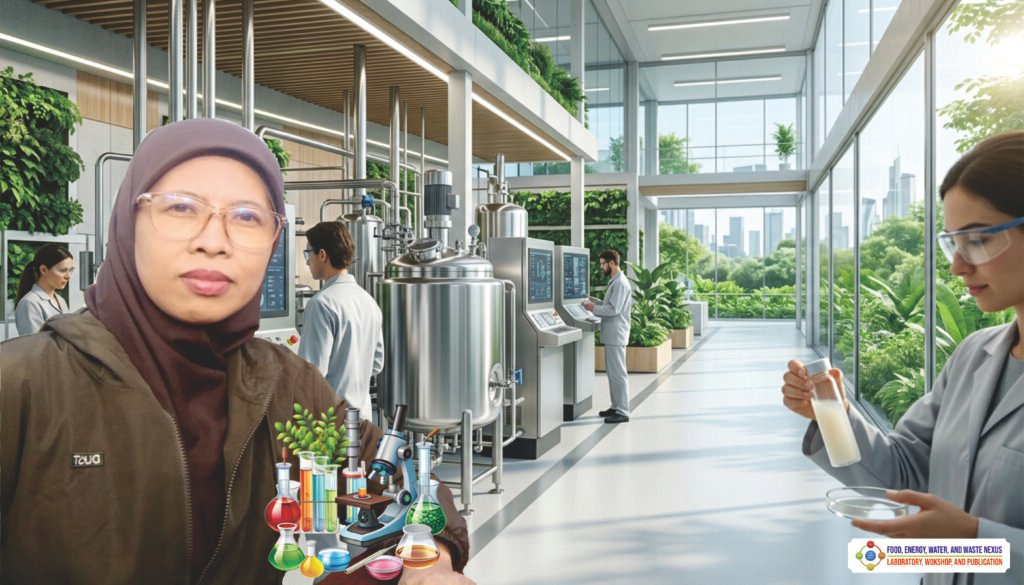
By: Kavadya Syska, S.P., M.Si. (Dosen Bidang Teknologi Pangan – Food Technologist, Universitas Nahdlatul Ulama Al Ghazali Cilacap / UNUGHA Cilacap)
The global food industry is entering a new era. Population growth, changing consumption patterns, environmental pressure, the climate crisis, limited land availability, and the rising demand for high-quality protein are driving the emergence of food innovations that are more efficient, sustainable, and technology-based. In the midst of these changes, precision fermentation has emerged as one of the most promising approaches for building the future of protein.
Protein has traditionally been obtained from animal sources such as meat, milk, eggs, and fish, as well as plant sources such as soybeans, legumes, cereals, and seeds. Both groups of protein will continue to play important roles in the food system. However, the continuously increasing global demand for protein requires new sources that are more efficient, stable, safe, and environmentally responsible. Precision fermentation offers such possibilities.
Precision fermentation is a technology that uses microorganisms such as yeast, bacteria, or fungi that are biologically engineered to produce specific food molecules in a highly targeted way. Through this approach, microorganisms can be “trained” to produce proteins, enzymes, fats, flavors, vitamins, or functional components that are usually obtained from animals or plants. The resulting ingredients can be used in food products such as alternative milk, cheese, ice cream, egg alternatives, plant-based meat, functional ingredients, and nutraceuticals.
The main strength of precision fermentation lies in its efficiency. Instead of raising animals for a long period to obtain certain proteins, this technology can produce specific food components in controlled bioreactors. The process can be designed to require less land, use less water, deliver more consistent quality, and potentially generate lower emissions than certain conventional production systems. In other words, precision fermentation does not only offer new food ingredients, but also a new way of producing food.
However, this technology should not be exaggerated as a single replacement for all existing protein systems. Precision fermentation does not mean eliminating agriculture, livestock, fisheries, or local foods. Instead, it should be positioned as a strategic complement to strengthen the food system. It can help provide high-protein ingredients, improve the texture and flavor of alternative products, enhance nutritional functions, and reduce pressure on natural resources.
For Indonesia, this issue is highly important. Indonesia has rich biodiversity, a long tradition of fermentation, local biomass resources, a large food market, and a growing need to strengthen protein independence. Tempeh, tape, soy sauce, oncom, dadih, bekasam, and various local fermented foods show that Indonesian society already has cultural familiarity with fermentation. The challenge is how to bring this fermentation tradition into modern food biotechnology that is safe, halal, affordable, and competitive.
Precision Fermentation as a New Protein Revolution
Fermentation has been part of human food civilization for thousands of years. Through fermentation, humans have transformed food ingredients into products that are more durable, safer, easier to digest, and richer in flavor. However, precision fermentation brings the concept of fermentation to a more advanced level. While traditional fermentation produces food through natural or semi-controlled microbial activity, precision fermentation targets the production of specific molecules.
In precision fermentation, microorganisms act as biological factories. With the help of biotechnology, microorganisms can produce milk proteins without cows, egg proteins without chickens, specific food enzymes, natural flavors, or high-value functional ingredients. After the fermentation process is complete, the target molecule is separated, purified, and formulated into food products.
This approach opens major possibilities for the food industry. One of the main challenges in alternative protein products is replicating the taste, texture, aroma, and technological function of animal proteins. Plant proteins often have limitations in solubility, texture, aftertaste, color, gel-forming ability, and emulsification performance. Precision fermentation can help overcome some of these limitations by producing more specific functional components.
For example, certain proteins can be used to improve the texture of alternative cheese, create a creamy sensation in plant-based milk, enhance emulsion stability, or improve the nutritional value of food products. Thus, precision fermentation does not merely produce “new protein,” but also helps improve the quality of alternative protein-based foods.
The future protein revolution will not be determined only by how much protein is produced, but also by quality, function, sustainability, safety, and consumer acceptance. Precision fermentation offers a pathway to produce proteins more precisely according to the needs of the modern food industry.
Sustainability and Resource Efficiency
One of the main reasons precision fermentation has gained significant attention is its potential to support sustainability. The global food system faces major pressure from land use, water consumption, greenhouse gas emissions, waste, and climate change. The production of certain animal proteins requires feed land, water, energy, and long supply chains. At the same time, demand for high-protein products continues to rise.
Precision fermentation can become one solution because the process takes place in a more controlled system. Production is carried out in bioreactors where parameters such as temperature, pH, nutrients, aeration, and fermentation time can be regulated. With this level of control, production can become more consistent and efficient.
In terms of land use, precision fermentation has the potential to reduce pressure for expanding production areas. Bioreactors require much less space than large-scale livestock-based protein production systems. In terms of water use, fermentation processes can be designed to be more efficient, with some process water potentially managed and reused. In terms of waste, fermentation residues can be further processed into feed, fertilizer, or other industrial materials if the system is designed circularly.
However, the sustainability of precision fermentation does not happen automatically. This process still requires energy, fermentation media, carbon sources, nitrogen, minerals, bioprocessing facilities, and purification systems. If the energy used still comes from fossil fuels and fermentation media are obtained from unsustainable supply chains, the environmental benefits may be reduced. Therefore, precision fermentation must be developed together with renewable energy, circular economy principles, and local raw material sources.
For Indonesia, this opens a strategic opportunity. Agroindustrial by-products such as molasses, starch hydrolysates, cassava residues, coconut residues, palm oil residues, and certain food industry residues can be studied as fermentation feedstocks. If developed safely and economically, precision fermentation can be connected with agroindustrial downstreaming and organic waste reduction.
Thus, the sustainability of precision fermentation is not determined only by microbial technology, but by the entire production ecosystem: energy, raw materials, processes, waste management, logistics, and markets.
Opportunities for the Indonesian Food Industry
Indonesia has a major opportunity to take part in the development of future protein. The Indonesian food market is large, protein consumption continues to grow, the middle class is expanding, and health awareness is increasing. At the same time, Indonesia faces challenges in equitable access to high-quality protein, stunting, food security, and dependence on imported food ingredients.
Precision fermentation can become one pathway to strengthen independence in functional food ingredients. Indonesia can develop proteins, enzymes, flavors, vitamins, or specific functional ingredients that have long depended heavily on imports. The national food industry needs various ingredients such as emulsifiers, enzymes, starter cultures, natural flavors, functional proteins, and texture-enhancing materials. Some of these ingredients can be developed through food biotechnology.
Another opportunity lies in developing alternative protein products based on local ingredients. Indonesia has soybeans, mung beans, peanuts, coconut, sorghum, cassava, mushrooms, seaweed, and many other plant-based ingredients. Precision fermentation can be used to improve the functionality, texture, taste, and nutritional value of products based on local materials. In this way, modern technology does not have to disconnect from local foods; instead, it can strengthen them.
The halal food industry is also a major opportunity. As a country with a large Muslim population, Indonesia needs to ensure that future protein meets halal principles, safety requirements, and traceability standards. Precision fermentation can be developed within a halal framework from the beginning, including microorganisms, fermentation media, processing aids, purification processes, and production facilities. If Indonesia can master this standard, it can become an important player in the biotechnology-based halal food market.
In addition, precision fermentation can encourage the emergence of science-based food startups. Universities, research institutions, business incubators, and industry can collaborate to develop microbial cultures, food formulations, bioprocess technologies, and commercial products. This will strengthen the national food innovation ecosystem.
However, these opportunities will only become reality if Indonesia does not merely become a consumer of technology. Indonesia needs to build research capacity, pilot plant facilities, clear regulations, bioprocess investment, biotechnology human resources, and industrial partnerships. Without these foundations, future protein will only appear as imported products sold in the domestic market.
Challenges of Safety, Regulation, and Consumer Acceptance
Precision fermentation brings great opportunities, but also challenges that must be managed carefully. The first challenge is food safety. Products produced through precision fermentation must undergo comprehensive evaluation related to toxicity, allergenicity, purity, stability, contaminants, and process safety. The microorganisms used must be proven safe, must not produce harmful compounds, and must not contaminate the production environment.
The second challenge is regulation. Precision fermentation products require a clear regulatory framework. Should such products be categorized as novel foods, food additives, processing aids, alternative proteins, or functional ingredients? How should safety assessment procedures be carried out? How should labeling be regulated? How should halal standards and traceability be applied? These questions must be answered so that industry has regulatory certainty.
The third challenge is consumer acceptance. Not all consumers immediately accept food produced through modern biotechnology. Some may have concerns about genetic engineering, long-term safety, product naturalness, or compatibility with religious and cultural values. Therefore, public communication must be honest, educational, and transparent.
The fourth challenge is price. Many precision fermentation products still require high production costs because industrial scale is still limited, purification processes are complex, and bioprocess infrastructure is expensive. To be widely accepted, products must become increasingly affordable. This requires production scale-up, fermentation media efficiency, microbial strain optimization, and the use of cheaper and cleaner energy.
The fifth challenge is halal compliance. In the Indonesian context, halal is not merely a label, but an assurance system from ingredients to processes. Fermentation media, enzymes, purification materials, production facilities, and potential cross-contamination must be carefully considered. If designed from the beginning based on halal principles, precision fermentation can gain stronger market trust.
The sixth challenge is technology access. If precision fermentation technology is controlled only by large global companies, developing countries risk becoming mere markets. Therefore, it is important for Indonesia to build national capacity so it does not fall behind in the new wave of food biotechnology.
By addressing these challenges openly, precision fermentation can develop as a food technology that is safe, ethical, and beneficial.
Precision Fermentation and Local Foods
One important point to emphasize is that precision fermentation must not distance Indonesia from local foods. On the contrary, this technology can become a tool to strengthen local food systems. Indonesia has a vast wealth of ingredients and food traditions. If combined with modern biotechnology, this richness can produce unique and competitive food innovations.
Indonesia has a strong fermentation tradition. Tempeh is an extraordinary example of plant-based protein through fermentation. Oncom, tape, soy sauce, tauco, dadih, bekasam, tempoyak, and various regional fermented foods show that fermentation is not foreign to Indonesian society. This tradition can become a cultural foundation for accepting and developing more advanced fermentation technologies.
Precision fermentation can help address some limitations of local foods. For example, certain plant-based ingredients may have beany aromas, less attractive textures, or suboptimal amino acid profiles. Through a combination of fermentation, enzymes, and formulation, local food products can be improved in sensory quality and nutritional value. Local proteins can become more acceptable to modern consumers.
In addition, precision fermentation can support the development of functional foods. Microorganisms can be used to produce bioactive compounds, functional peptides, digestive enzymes, vitamins, or components that support health. If developed based on local materials, Indonesia can build a functional food industry that does not merely follow global trends, but has a national identity.
However, caution is needed so that this technology does not replace local food diversity with uniform products controlled by large industries. Future food should continue to respect cultural diversity, local farmers, MSMEs, and regional food systems. Precision fermentation must become a tool for empowerment, not a tool for food homogenization.
With the right approach, Indonesia can develop a model of “local-based food biotechnology”: modern in technology, yet rooted in Indonesian ingredients, culture, and community needs.
Strategies for Developing Precision Fermentation in Indonesia
The first strategy is to strengthen basic and applied research. Universities and research institutions need to develop research on microorganisms, local strains, metabolic engineering, bioprocessing, fermentation media, protein purification, food formulation, safety, and sensory evaluation. Research should not be directed only toward publications, but also toward prototypes, patents, pilot plants, and commercial products.
The second strategy is to build bioprocess pilot plant facilities. Many food innovations fail to develop because there is no bridge between laboratory and industry. Pilot plants are needed to test production scale, process efficiency, safety, cost, and product quality. These facilities can be developed through collaboration among government, universities, state-owned enterprises, and private industry.
The third strategy is to develop local fermentation feedstocks. Indonesia needs to explore the potential of molasses, cassava starch, sago hydrolysate, coconut residues, agroindustrial by-products, and other local carbon sources as fermentation media. This is important so that precision fermentation does not depend entirely on imported inputs.
The fourth strategy is to establish adaptive regulation. The government needs to provide safety assessment pathways, labeling standards, halal rules, and clear licensing procedures. Regulation must protect consumers while not suppressing innovation. Regulatory certainty will encourage investment.
The fifth strategy is to strengthen food biotechnology human resources. Indonesia needs experts in microbiology, bioprocessing, food engineering, food safety, bioinformatics, regulation, halal assurance, and technology commercialization. Vocational education is also needed to prepare bioreactor operators and fermentation industry technicians.
The sixth strategy is to build an industrial ecosystem. Startups, innovative MSMEs, large food industries, cooperatives, investors, and government need to be connected. Precision fermentation requires a long value chain, from microbial strains, media, bioreactors, purification, formulation, packaging, to marketing.
The seventh strategy is to build transparent public communication. Consumers need to understand what precision fermentation is, how products are made, why they are safe, what their halal status is, and what benefits they offer. Closed communication will only create suspicion. Transparency is the key to trust.
Conclusion
Future Protein: Precision Fermentation and a New Pathway for a Sustainable Food Industry emphasizes that the future of protein will not be determined only by increasing animal or plant production, but also by the ability to develop new food technologies that are efficient, safe, sustainable, and aligned with societal needs. Precision fermentation offers an important pathway to produce proteins and functional food ingredients more precisely through microorganisms in controlled bioprocess systems.
This technology has the potential to reduce pressure on land, water, and natural resources while opening opportunities for food product innovation. However, precision fermentation is not an absolute replacement for agriculture and livestock. It must be positioned as a complement within a more diverse, fair, and sustainable protein system.
For Indonesia, precision fermentation can become a strategic opportunity to strengthen food ingredient independence, the halal industry, functional foods, alternative proteins, and agroindustrial downstreaming. With its rich local food heritage and strong fermentation tradition, Indonesia has both cultural and biological capital to develop this technology in a distinctive way. However, this opportunity requires serious preparation. Research, pilot plants, regulation, halal standards, human resources, financing, industry, and public communication must be developed in an integrated manner. Otherwise, Indonesia will only become a market for future protein products from abroad. Conversely, if managed with a strong vision, precision fermentation can become one of the new pathways toward an Indonesian food industry that is more independent, innovative, sustainable, and globally competitive.
