
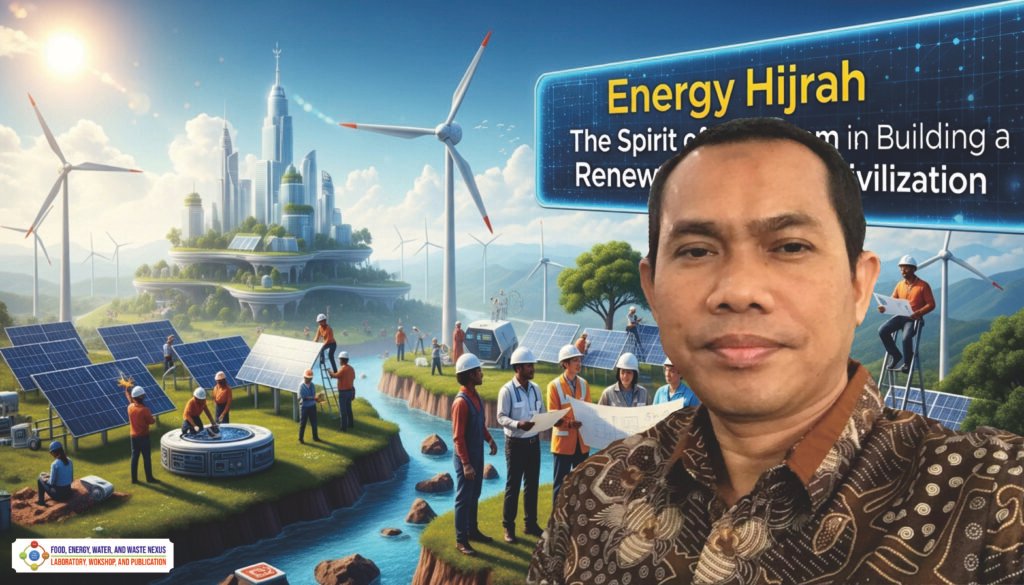
By: Ropiudin, S.TP., M.Si. (Dosen Bidang Teknik Sistem Termal dan Energi Terbarukan, Universitas Jenderal Soedirman)
Muharram is not merely the beginning of a new year in the Hijri calendar. It is also a reflective moment to reconsider the direction of human life, civilization, and responsibility toward nature. The spirit of hijrah embedded in Muharram carries a profound message of transformation: moving from destruction toward restoration, from dependence toward independence, from wastefulness toward sustainability, and from exploitation toward stewardship.
In the modern context, this spirit of hijrah is highly relevant to the global agenda of energy transition. The world is now facing climate crisis, environmental degradation, and prolonged dependence on fossil energy. Coal, oil, and natural gas have indeed supported global economic growth for centuries. However, they have also become major contributors to carbon emissions, air pollution, and ecological imbalance. Therefore, energy hijrah is no longer merely a technical option; it is a strategic necessity.
Energy hijrah can be understood as a paradigm shift from a fossil-based energy system toward a renewable energy system that is clean, just, and sustainable. Solar energy, wind power, bioenergy, geothermal energy, micro-hydro, green hydrogen, and energy storage technologies are essential components of this future. Nevertheless, this transition should not be viewed only as the replacement of one energy source with another. More fundamentally, energy hijrah must be understood as a transformation of values, culture, policy, technology, and social behavior in the responsible use of energy.
For Indonesia, energy hijrah has a highly strategic meaning. Indonesia possesses abundant renewable energy potential, including year-round solar radiation, vast geothermal resources, agricultural and forestry residues for bioenergy, and wind and hydropower potential in various regions. However, this potential has not yet become the main strength of the national energy system. Dependence on fossil energy remains high, while renewable energy development still faces technological, investment, infrastructure, regulatory, and human resource challenges.
Therefore, the spirit of Muharram can serve as a moral and philosophical foundation to strengthen the nation’s commitment to building a renewable energy civilization. Energy hijrah is not only the agenda of government and industry. It is also a collective calling for academics, Islamic boarding schools, universities, entrepreneurs, rural communities, and younger generations to take part in this great transformation.
The Spirit of Muharram and Ecological Awareness
Muharram teaches the importance of muhasabah, or deep self-reflection on what has been done and what must be improved. In the context of energy, muhasabah means reassessing patterns of energy production and consumption that have often been wasteful, exploitative, and insufficiently concerned with long-term environmental impacts. Climate crisis, floods, droughts, air pollution, and ecosystem degradation are signs that the relationship between humans and nature must be reorganized.
Ecological awareness is an essential part of energy hijrah. Humanity can no longer view nature merely as an object of economic exploitation. Nature is a trust that must be protected, managed, and passed on to future generations in a better condition. From this perspective, renewable energy is not only a technology, but also a manifestation of human moral responsibility toward God’s creation.
The use of solar energy, bioenergy, micro-hydro, and other clean energy sources can become a concrete expression of this ecological ethic. When rural communities are able to transform agricultural residues into biogas, biomass pellets, or alternative fuels, energy becomes not only a production tool, but also an instrument of empowerment. When schools, universities, mosques, and Islamic boarding schools begin to use solar panels, educational and religious spaces also become centers of clean energy literacy.
Thus, Muharram can become a momentum for building an ecological hijrah movement. This movement does not stop at spiritual symbolism, but must be realized through concrete actions: saving energy, reducing dependence on fossil fuels, developing appropriate technology, strengthening renewable energy research, and embedding environmental awareness in everyday life.
Building a Renewable Energy Civilization
A renewable energy civilization is a civilization that places energy as a means to create justice, welfare, and sustainability. In this civilization, energy is not measured only by the amount of electricity generated, but also by the extent to which it improves human quality of life without damaging the environment.
Indonesia has a great opportunity to build a renewable energy civilization. As a tropical country, Indonesia receives high solar radiation throughout the year. This potential can be utilized for solar power plants, solar-based agricultural dryers, solar-powered irrigation systems, renewable energy-based cold storage, and the electrification of remote villages. On the other hand, as an agrarian country, Indonesia also has abundant bioenergy resources from agricultural, plantation, livestock, and forestry residues.
However, building a renewable energy civilization cannot be done partially. It requires integration among national energy policy, local industrial development, university research, green financing, public literacy, and the strengthening of energy storage technologies. Renewable energy sources, especially solar and wind, are intermittent. Therefore, energy storage systems such as batteries, thermal energy storage, green hydrogen, and smart grids are needed to maintain stable and reliable energy supply.
In addition, renewable energy development must also pay attention to social justice. Energy transition must not only benefit groups that already have capital and access to technology. Rural communities, fishers, farmers, micro, small, and medium enterprises, Islamic boarding schools, and remote communities must become primary beneficiaries. Otherwise, energy transition may create new gaps between central and regional areas, urban and rural communities, and those who can access technology and those who are left behind.
Therefore, a renewable energy civilization must be built upon the principle of energy justice. Every citizen has the right to access clean, affordable, safe, and sustainable energy. The spirit of Muharram reminds us that true transformation is not only about technological progress, but also about ensuring that progress brings benefit and welfare to all.
Downstreaming Renewable Energy in Indonesia
Renewable energy downstreaming is a key strategy for realizing national energy independence. Downstreaming does not only mean processing natural resources into higher-value products. It also means building a clean energy industrial ecosystem from upstream to downstream. Indonesia should not only become a market for renewable energy technologies. It must also become a producer, innovator, and developer of technologies that suit local needs.
In the context of solar energy, downstreaming can be carried out by strengthening domestic industries for solar panels, inverters, batteries, control systems, and supporting components. In bioenergy, downstreaming can be directed toward the development of biogas, biomass pellets, bioethanol, biodiesel, biochar, and solid biomass for household needs, small industries, and power generation. In geothermal energy, downstreaming can be realized through the development of exploration technology, drilling technology, turbines, monitoring systems, and the direct use of geothermal heat for agriculture, drying, and food industries.
Universities and research institutions hold a strategic position in this downstreaming agenda. Universities should not only function as centers of education, but also as centers of renewable energy technology innovation. Research on solar dryers, thermal energy storage systems, clean biomass combustion, smart grids, artificial intelligence for energy optimization, and battery materials must be strengthened to address the needs of industry and society.
Islamic boarding schools and Islamic educational institutions can also play an important role in energy hijrah. With their large number and wide distribution across regions, Islamic boarding schools can become centers of education, demonstration, and community-based renewable energy implementation. Solar-powered pesantren programs, pesantren biogas systems, organic waste-to-energy processing, and energy-saving literacy can serve as concrete examples of the integration between religious values and technological innovation.
Renewable energy downstreaming must also reach rural communities. Villages have great potential as centers of local bioenergy, micro-hydro, solar power, and independent energy systems. Through energy villages, communities can convert agricultural waste into energy sources, use solar panels for productive activities, and develop local economies based on clean energy. In this way, energy downstreaming does not only create economic value, but also strengthens community independence and social resilience.
Technological Challenges and Transformation Strategies
Although Indonesia has enormous renewable energy potential, its implementation challenges are not simple. One major challenge is technological and infrastructural readiness. Many regions with renewable energy potential are not yet supported by adequate electricity networks, energy storage systems, financing access, and technical human resources. As a result, renewable energy utilization has not yet reached its full potential.
Another challenge is the relatively high initial investment cost. Solar panels, batteries, control systems, turbines, and energy storage technologies still require substantial capital. For rural communities, micro and small enterprises, and small educational institutions, this cost often becomes a major barrier. Therefore, creative financing schemes are needed, such as targeted subsidies, green credit, energy waqf, energy cooperatives, and partnerships among government, universities, industry, and communities.
Another challenge is the low level of clean energy literacy. Many people do not yet fully understand the long-term benefits of renewable energy from economic, environmental, and health perspectives. This is where energy education becomes essential. Schools, universities, Islamic boarding schools, community organizations, and the media need to become agents of renewable energy literacy so that the transformation is not merely technocratic, but also cultural.
From the policy perspective, regulatory consistency and long-term commitment are required. Energy transition cannot run effectively if policies keep changing, incentives remain unclear, and local industries are not strategically protected. The government must ensure that renewable energy development is not treated as a short-term project, but as part of the national agenda toward energy sovereignty and low-carbon development.
Energy transformation strategies must be implemented gradually, measurably, and inclusively. First, Indonesia must accelerate renewable energy use in sectors that are most ready, such as rooftop solar power, solar dryers, village bioenergy, and the electrification of public facilities. Second, research and local industries must be strengthened so that Indonesia does not depend entirely on imported technologies. Third, energy storage systems and digitalized electricity networks must be developed. Fourth, vulnerable communities must receive direct benefits from the energy transition. Fifth, spiritual values and environmental ethics must become the foundation for changing energy behavior.
Conclusion
Energy Hijrah: The Spirit of Muharram in Building a Renewable Energy Civilization emphasizes that energy transition is not only a technological agenda, but also a moral, social, economic, and civilizational agenda. Muharram delivers a profound message of transformation: humanity must have the courage to leave behind old destructive patterns and move toward a new order that is cleaner, fairer, and more sustainable.
For Indonesia, energy hijrah is highly important amid the challenges of climate crisis, fossil energy dependence, unequal energy access, and national economic development needs. Renewable energy offers a pathway toward energy independence, emission reduction, green job creation, rural empowerment, and national competitiveness. However, the success of this transition depends greatly on downstreaming strategies, research strengthening, technological readiness, inclusive financing, and social justice.
The spirit of Muharram reminds us that great transformation must begin with awareness, continue with knowledge, be strengthened through policy, and be realized through concrete action. By integrating spiritual values, technological innovation, and sustainability commitment, Indonesia has a great opportunity to build a renewable energy civilization that is not only low-carbon, but also just, independent, and beneficial for future generations.
