
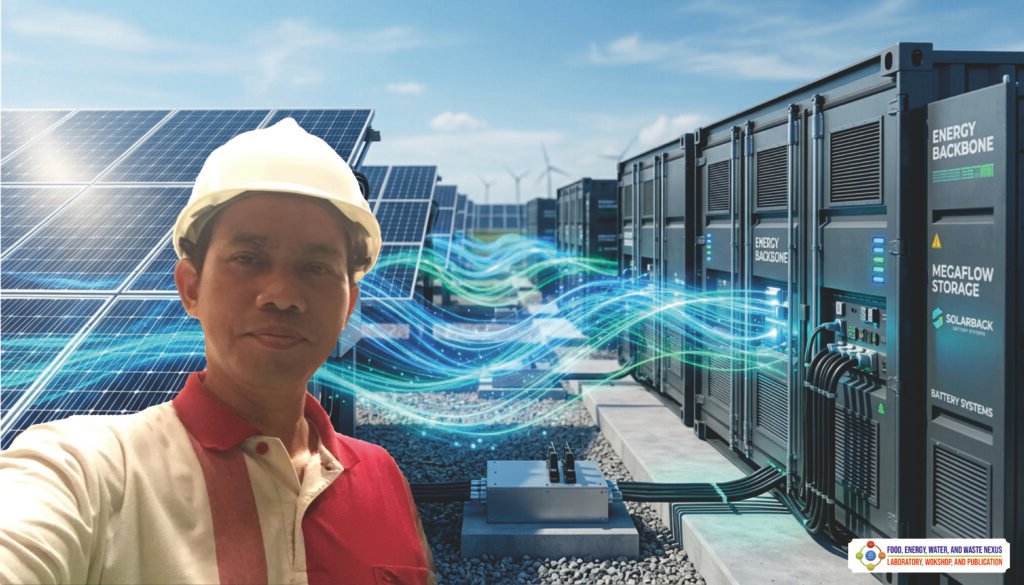
By: Ropiudin, S.TP., M.Si. (Dosen Bidang Teknik Sistem Termal dan Energi Terbarukan, Universitas Jenderal Soedirman)
Moving toward a clean energy future is no longer merely an ideal discourse, but a concrete direction in the transformation of the global electricity system. In recent years, solar photovoltaic power generation, or solar PV, has grown rapidly and become one of the most competitive renewable energy technologies in the world. This development has become even stronger as solar PV is no longer deployed as a stand-alone technology, but increasingly integrated with battery-based energy storage systems.
The surge of solar PV and batteries marks a new phase in the energy transition. Previously, solar energy was often viewed as an unstable source of electricity because it depends on solar radiation. Today, this limitation can increasingly be addressed through battery energy storage systems, or BESS. Batteries allow electricity generated during the day to be stored and used at night or during peak demand. As a result, solar PV is no longer merely a supplementary power source, but is moving toward becoming the backbone of the future energy system.
Globally, batteries have become one of the fastest-growing clean energy technologies. The development of lithium-iron phosphate, or LFP, batteries has further strengthened the market because they are relatively cheaper and suitable for frequent cycling in electricity systems. Cost reduction has also become a crucial factor. The declining cost of utility-scale battery storage has improved the competitiveness of solar-plus-storage projects, especially in electricity systems seeking to replace fossil-based power generation.
However, the surge of solar PV and batteries should not be understood only as a technological phenomenon. It represents a major transformation in the architecture of the global energy system. The future electricity system will no longer rely entirely on large centralized fossil-fuel power plants, but on a combination of clean power generation, energy storage, grid digitalization, demand response, and smarter load management.
Solar PV and Batteries in Indonesia’s Energy Transition
For Indonesia, the surge of solar PV and batteries has strategic significance. Indonesia is a tropical country with abundant solar radiation throughout the year. Almost all regions of Indonesia have opportunities to develop solar energy, whether through rooftop solar PV, floating solar PV, utility-scale solar farms, or independent solar systems for remote areas. However, solar PV utilization in Indonesia has not yet reached its full potential due to regulatory challenges, financing barriers, grid readiness, and limited energy storage deployment.
The integration of solar PV with batteries can become an important solution for Indonesia’s geographical character as an archipelagic country. Many small islands and remote areas still depend on diesel power plants, which are expensive, polluting, and highly dependent on fuel distribution. With solar PV and batteries, these areas can develop cleaner, more independent electricity systems with lower operating costs in the long term.
Floating solar PV is also becoming an important direction for solar energy development in Indonesia. Reservoirs, lakes, and other water bodies can be utilized to generate electricity without creating major land-use conflicts. Floating solar also has the potential to reduce evaporation and improve panel performance through the cooling effect of water. This makes it highly relevant for a densely populated and geographically diverse country such as Indonesia.
However, Indonesia should not focus only on installing solar panels. The greater challenge lies in building a complete ecosystem for solar energy and battery storage. If solar PV grows without adequate grid readiness and energy storage systems, its potential may be constrained by curtailment, supply instability, and difficulties in integration with the national electricity system.
This shows that the energy transition does not only require new power plants. It also requires large investments in grid infrastructure, system flexibility, digital monitoring, energy storage, and institutional readiness. Without these foundations, solar PV and batteries cannot function optimally as the backbone of the energy transition.
Downstreaming Solar PV and Batteries in Indonesia
The surge of solar PV and batteries should become a momentum for Indonesia to strengthen its clean energy downstreaming strategy. In this context, downstreaming is not only about building renewable power projects, but also about strengthening the entire value chain of clean energy technology from upstream to downstream. Indonesia should not merely become a market for imported solar panels, batteries, inverters, and control systems. It must move toward becoming a producer, developer, and innovator of clean energy technologies.
In the solar PV industry, downstreaming can begin with strengthening domestic manufacturing of solar modules, mounting structures, inverters, monitoring systems, cables, electrical components, and engineering, procurement, installation, operation, and maintenance services. Meanwhile, in the battery industry, downstreaming should be directed toward mastering material technology, battery cells, battery packs, battery management systems, battery recycling, and the integration of batteries with renewable power generation.
Indonesia holds a strategic position in the battery supply chain because of its important mineral resources. However, mineral advantage does not automatically become technological advantage. Without research, design capability, precision manufacturing, standardization, and a strong industrial ecosystem, Indonesia risks becoming only a supplier of raw materials or a site for limited-value assembly.
Therefore, the downstreaming of solar PV and batteries must be supported by universities, polytechnics, research institutions, national industries, and technology certification centers. Universities need to strengthen research on battery materials, energy storage systems, smart grids, power electronics, artificial intelligence for energy management, and the integration of solar PV with productive loads such as agricultural dryers, cold storage, irrigation pumps, and small-scale industries.
Downstreaming must also reach grassroots communities. Solar PV and batteries can become the foundation for energy-independent villages, solar-powered Islamic boarding schools, energy cooperatives, fishery cold storage, solar-based food dryers, and electricity systems for rural micro, small, and medium enterprises. In this way, solar PV and batteries are not only symbols of the energy transition, but also instruments for economic equity and community empowerment.
Technological Challenges and Transformation Strategies
Although solar PV and batteries have strong prospects, their challenges remain complex. The first challenge is intermittency. Solar PV generates electricity optimally only when sunlight is available. Batteries can indeed help address this issue, but storage capacity, lifetime, efficiency, and system cost must be carefully calculated so that projects remain technically and economically feasible.
The second challenge is grid readiness. The greater the penetration of solar PV, the greater the need for a flexible electricity network. The grid must be able to absorb variable electricity supply, manage two-way power flows, regulate peak loads, and prevent voltage and frequency disturbances. Without grid modernization, solar PV and batteries cannot function effectively as the backbone of the energy transition.
The third challenge is financing. Although the cost of solar PV and batteries continues to decline, the initial investment remains relatively high, especially for households, micro and small enterprises, schools, Islamic boarding schools, and villages. Therefore, creative financing schemes are needed, such as green credit, solar leasing, energy cooperatives, productive waqf-based financing, targeted subsidies, and partnerships among government, private sector, universities, and communities.
The fourth challenge is human resource readiness. The installation and operation of solar PV-battery systems require technical personnel who understand system design, electrical safety, battery management, grid protection, maintenance, and energy feasibility analysis. Vocational education and technical training must therefore be strengthened so that the energy transition does not depend entirely on external expertise.
The fifth challenge is battery waste management. As battery use expands, recycling systems and end-of-life management become increasingly important. The energy transition must not create new environmental problems. For this reason, battery industry development must be accompanied by circular economy principles, including material recycling, safety standards, and proper hazardous waste management.
Transformation strategies must be implemented in an integrated manner. First, Indonesia needs to accelerate solar PV development in the most ready sectors, such as rooftop solar, floating solar, public facilities, industrial zones, and small islands. Second, battery integration or other flexibility systems should be encouraged for selected solar PV projects according to grid needs. Third, local solar PV and battery industries must be strengthened so that Indonesia does not merely become a technology market. Fourth, grid modernization must be accelerated through smart grids, digital monitoring, and demand response. Fifth, vulnerable communities must receive direct benefits through community-based clean energy programs.
Conclusion
The surge of solar PV and batteries as the backbone of the energy transition shows that the clean energy future is becoming closer and more realistic. Solar PV offers an abundant, clean, and increasingly affordable source of electricity, while batteries provide the flexibility needed to address intermittency and maintain power system reliability. Together, these technologies form an essential foundation for a low-carbon energy system, especially in an archipelagic country such as Indonesia.
However, the success of solar PV and batteries is not determined merely by how much capacity is installed. True success depends on grid readiness, regulatory quality, financing schemes, industrial downstreaming, technological mastery, human resource capacity, and equitable access for communities. Without a comprehensive strategy, the surge of solar PV and batteries risks becoming only an investment trend rather than a truly just energy transformation.
Indonesia needs to use this momentum as a pathway toward national energy independence. With its large solar potential, mineral resources for batteries, growing electrification needs, and vast archipelagic territory, Indonesia has the opportunity to become a center for solar PV-battery development in Southeast Asia. However, this opportunity can only be realized if the energy transition is directed not merely toward replacing electricity sources, but toward building a clean energy ecosystem that is independent, inclusive, competitive, and sustainable. Ultimately, solar PV and batteries are not merely technologies. They are symbols of a civilizational shift in energy: from dependence on fossil fuels toward clean energy independence; from centralized systems toward more participatory systems; and from exploitative development toward sustainable development. If managed with a long-term vision, the surge of solar PV and batteries can become Indonesia’s main foundation for entering a just, modern, and low-carbon energy transition era.
