
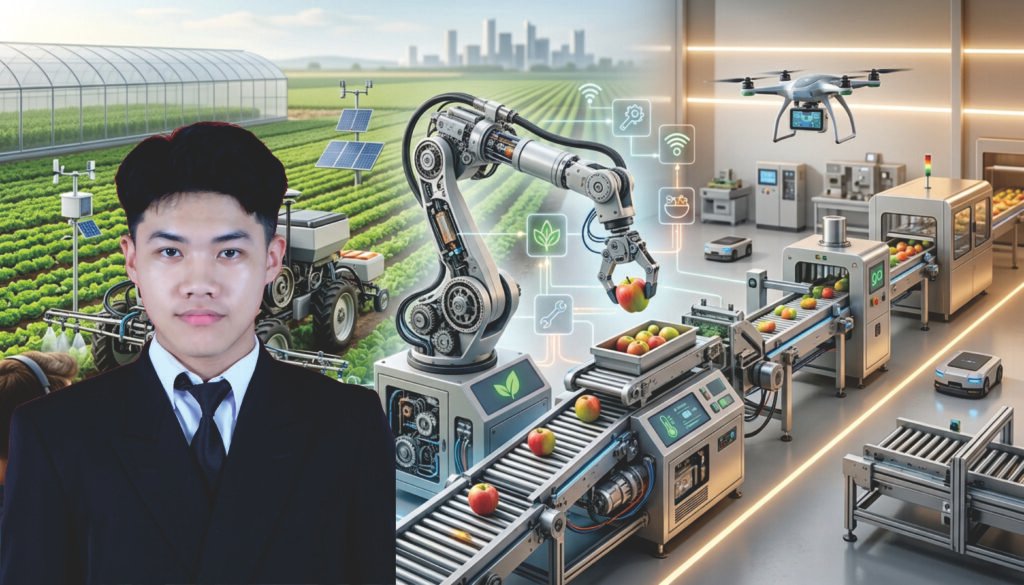
By: Muhammad Rafi Farras (Mechanical Engineering Undergraduated Student, Faculty of Engineering, Brawijaya University)
Mechanical engineering is often perceived as a field closely related to industrial machinery, automotive systems, manufacturing, energy, materials, and mechanical design. This perception is not wrong, but it does not fully capture the breadth of mechanical engineering’s role in society. Amid the world’s need for safer, more efficient, more sustainable, and higher-value food systems, mechanical engineering has become one of the most important disciplines in shaping the future of agriculture, food, and agroindustry.
Modern agriculture can no longer rely solely on human labor, inherited experience, and simple tools. Today’s agricultural challenges are far more complex: productivity must increase, postharvest losses must be reduced, product quality must become more uniform, energy use must be more efficient, emissions must be lowered, and supply chains must become faster and more measurable. All these challenges require support from mechanical technology, thermal systems, automation, sensors, robotics, machine design, and process engineering.
This is where mechanical engineering finds its new relevance. Mechanical engineering is not only about designing machines; it is about designing production systems that connect agricultural land, postharvest handling, food processing, storage, distribution, and downstream industries. From tractors to drones, from planting machines to harvesters, from grain dryers to cold storage, from irrigation pumps to biomass boilers, from sensor-based fruit sorting to smart food factories—all require the foundations of mechanical engineering.
Agriculture and food are biological sectors, but their success is strongly determined by mechanical and thermal systems. Paddy that is not dried immediately can deteriorate. Fruit that is not properly sorted can lose market value. Vegetables that are not cooled quickly wilt. Milk that is not properly pasteurized poses safety risks. Food products processed without control of temperature, pressure, flow, humidity, and time can fail in quality. All this shows that food is not only a matter of cultivation and nutrition, but also a matter of engineering.
Future agroindustry requires a more precise approach. Machines must not only be strong; they must be efficient, hygienic, easy to maintain, energy-saving, suitable for business scale, and capable of producing consistent quality. Processing systems must not only operate; they must be measurable, controllable, and data-driven. Technology must not only be modern; it must fit the needs of farmers, MSMEs, cooperatives, and the national food industry.
For Indonesia, the role of mechanical engineering in agriculture, food, and agroindustry is highly strategic. Indonesia is an agrarian and maritime country with abundant commodities: rice, corn, coconut, coffee, cocoa, sugarcane, banana, cassava, sago, spices, tropical fruits, fisheries products, and livestock products. However, many commodities are still sold as raw materials, experience postharvest losses, or have not achieved optimal added value. To change this situation, Indonesia needs machines, systems, and process technologies capable of upgrading local products.
Thus, mechanical engineering for agriculture, food, and agroindustry is not merely a supporting field. It is a foundation of transformation. It connects primary production with downstream industry, converts raw materials into value-added products, reduces food losses, improves energy efficiency, and strengthens national competitiveness. The future of Indonesian food is not determined only by land and commodities, but also by the nation’s ability to design intelligent agroindustrial machines and systems.
Mechanical Engineering and the Transformation of Modern Agriculture
Modern agriculture requires appropriate mechanization. Mechanization is not simply replacing human labor with machines, but improving work efficiency, process accuracy, productivity, safety, and output consistency. In agriculture, mechanical engineering plays a role in designing soil preparation equipment, planting machines, fertilizer applicators, harvesters, irrigation systems, pumps, sprayers, conveyors, and various supporting production tools.
However, agricultural mechanization in Indonesia cannot simply imitate models from other countries. Indonesian agricultural land has diverse characteristics: small rice fields, sloping land, smallholder plantations, large estates, wetlands, drylands, and remote areas. Therefore, agricultural machines must be designed according to local contexts. Machines that are too large may not suit small farmers. Machines that are too expensive may be inaccessible to cooperatives. Machines that are difficult to maintain may end up unused.
This is why contextual mechanical engineering is important. Agricultural machines must follow the principle of appropriate technology: suitable in scale, easy to operate, easy to repair, fuel-efficient, and capable of increasing users’ economic value. The best technology is not always the most sophisticated one, but the technology that can truly be used and deliver real benefits.
Mechanical engineering also plays a role in precision agriculture. Soil moisture sensors, automatic irrigation pumps, fertigation systems, spraying drones, weeding robots, and field-monitoring tools require the integration of mechanics, electronics, control systems, and energy. Although some of these technologies appear digital, their foundations remain mechanical: tool structure, motion systems, actuators, transmission, nozzle design, fluid flow, and energy efficiency.
In the future, Indonesian agriculture needs to move from basic mechanization toward intelligent mechanization. Machines should not only work, but also read conditions, adjust operations, and generate data. Mechanical engineering must become the bridge between farmers’ needs and digital technology.
Postharvest Handling as a Critical Point in Agroindustry
One of the major problems in Indonesian agriculture is postharvest loss. Many agricultural products are not damaged in the field, but after harvest. Paddy can lose quality because of delayed drying. Corn can become moldy because of high moisture content. Fruit can bruise during transportation. Vegetables can wilt because they are not cooled quickly. Fish can lose quality because of weak cold-chain systems.
Postharvest handling is an area that urgently requires mechanical engineering. Cleaning, sorting, grading, drying, cooling, packaging, storage, and transportation all require well-designed machines and systems. Each commodity has different characteristics and cannot be treated in the same way.
Paddy requires drying that can reduce moisture content without damaging rice quality. Corn requires fast and safe drying to prevent mold. Fruit requires gentle sorting to avoid bruising. Vegetables require rapid cooling to maintain freshness. Fisheries products require stable cold chains. All these are areas of mechanical engineering work.
Postharvest technology also determines added value. Properly dried products have longer shelf life. Products sorted by quality can be sold at better prices. Products cooled correctly can reach more distant markets. Products packaged properly can enter modern retail.
Therefore, investment in postharvest technology is as important as increasing production. There is little value in increasing harvest volume if much of the quality is lost after harvest. Mechanical engineering must be present to close the gap between production and market.
Drying Technology as the Heart of Postharvest Processing
Drying is one of the most important processes in tropical agroindustry. Many Indonesian commodities have high moisture content and are vulnerable to deterioration if not dried immediately. Rice, corn, coffee, cocoa, coconut, spices, cassava, fish, fruit, and various food products require drying as a major preservation step.
From a mechanical engineering perspective, drying is a heat and mass transfer process. Hot air carries energy to evaporate water from the material. Humidity, temperature, airflow rate, material thickness, particle size, and processing time strongly determine the final result. Drying that is too slow can trigger mold growth. Drying that is too hot can damage color, aroma, nutrients, and seed viability. Non-uniform drying causes some materials to become overly dry while others remain wet.
This is where the role of mechanical engineering is very strong. Dryer design requires an understanding of thermodynamics, fluid mechanics, heat transfer, temperature control, air distribution, energy efficiency, and material quality. A dryer must not only generate heat; it must produce controlled and uniform heat.
Indonesia needs various types of dryers: solar dryers, hybrid dryers, biomass dryers, fluidized bed dryers, bed dryers, tray dryers, rotary dryers, vacuum dryers, and heat-pump dryers. Each technology has different applications. High-value products such as spices, fruits, or functional ingredients require more careful temperature control. Grains require large capacity and energy efficiency. MSMEs require equipment that is affordable, simple, and hygienic.
Drying must also be linked to renewable energy. Biomass, solar energy, PV/T, thermal energy storage, and heat recovery can make drying more energy-efficient and sustainable. This is a major research and innovation space for mechanical engineering in Indonesia.
Cold Chain and Refrigeration to Reduce Food Loss
In addition to drying, the cold chain is an important requirement in modern food systems. Fresh products such as vegetables, fruits, fish, meat, milk, and processed foods deteriorate quickly if temperature is not controlled. Without proper cooling, products lose freshness, nutritional value, safety, and economic value.
Mechanical engineering plays the main role in cold chains. Refrigeration systems, compressors, evaporators, condensers, heat exchangers, insulation, temperature control, cold air distribution, cold storage, refrigerated trucks, and display cabinets all fall within the scope of mechanical engineering. The efficiency of cooling systems strongly determines operating costs and carbon footprint.
In Indonesia, cold-chain challenges are significant. Many production areas are far from markets. Electricity infrastructure is uneven. Energy costs are high. MSMEs often lack cold storage. As a result, fresh products are sold quickly at low prices or deteriorate before reaching consumers.
The solution is not only to build large cold storage facilities, but to design cold-chain systems appropriate to scale. Solar cold storage, modular cold rooms, ice thermal storage, evaporative cooling, portable cold boxes, and energy-efficient refrigeration systems can all be options. For coastal regions and agricultural centers, renewable-energy-based cold chains are highly relevant.
Mechanical engineering must also pay attention to environmentally friendly refrigerants. Many cooling systems still use refrigerants with high global warming potential. The future of food refrigeration must move toward systems that are more efficient, safer, and lower in emissions.
Cold chain is not merely cold storage. It is a system for preserving food value. With a good cold chain, farmers, fishers, MSMEs, and consumers all benefit.
Food Processing Machines and Downstreaming of Local Commodities
Indonesia has many superior commodities, but their added value is often low because they are sold in raw form. Coconut is sold as whole fruit or copra, cassava as raw material, banana as fresh fruit, cocoa as beans, coffee as green beans, spices as dried raw materials, and fisheries products as fresh commodities. In fact, economic value increases when commodities are processed into value-added food products.
Downstreaming requires processing machines. Graters, presses, extractors, dryers, mills, mixers, sieves, packaging machines, pasteurizers, evaporators, fermenters, roasters, fryers, extruders, and forming machines are important parts of agroindustry. Without appropriate processing machines, local commodities struggle to move up the value chain.
Mechanical engineering plays a role in designing machines that suit the characteristics of food materials. Food materials are not the same as ordinary industrial materials. They are sensitive to temperature, pressure, friction, oxygen, humidity, contamination, and processing time. Food machines must be hygienic, easy to clean, gentle on materials, and capable of maintaining quality.
In small industries, machines must be simple but effective. Many MSMEs need machines with medium capacity, affordable prices, good energy efficiency, and easy maintenance. Imported machines are often unsuitable for local materials or too expensive. This opens a major opportunity for domestic machine designers.
Local food downstreaming will not succeed through entrepreneurial spirit alone. It requires process technology. Mechanical engineering is the foundation that enables raw materials to become value-added, stable, safe, and market-ready products.
Renewable Energy for Agroindustry
Agroindustry requires substantial energy. Drying, cooling, heating, milling, packaging, transportation, and processing require electricity and heat. If all energy comes from fossil fuels, costs are high and emissions increase. Therefore, integrating renewable energy becomes an important agenda.
Mechanical engineering plays a role in designing agroindustrial energy systems. Agricultural biomass can be used as fuel for boilers, gasifiers, or drying furnaces. Coconut residues, rice husks, corn cobs, sugarcane bagasse, coffee husks, palm shells, and other agricultural residues can become energy sources if converted with appropriate technology.
Solar energy is also highly relevant. Solar dryers, PV for irrigation pumps, PV for cold storage, and PV/T for drying systems can help reduce energy costs. Thermal energy storage can store heat for use when solar radiation decreases or when processes require temperature stability.
Bioenergy and solar energy can be combined in hybrid systems. For example, a dryer can use solar heat during the day and biomass at night or during cloudy weather. Cold storage can use PV, batteries, and ice-based cold storage. Such systems require good mechanical, thermal, and control design.
Renewable energy for agroindustry is not only an environmental issue, but also an economic one. If energy costs decrease, product competitiveness improves. If energy becomes available in villages, local agroindustry can grow. Mechanical engineering has a strategic role in making this possible.
Sensors, Automation, and Precision Agroindustry
Precision agroindustry requires data. Future machines must not only rotate, heat, cool, or mix. Machines must be able to measure, monitor, and control processes. Temperature, humidity, pressure, flow rate, moisture content, color, weight, viscosity, Brix, pH, and visual quality sensors are becoming important parts of modern food production systems.
Automation enables processes to run more consistently. In dryers, sensors can control temperature and airflow. In cold storage, automatic controls maintain temperature and humidity. In sorting machines, cameras and sensors can separate products based on size, color, and quality. In packaging lines, automatic systems can improve speed and hygiene.
Artificial intelligence can bring automation to a higher level. AI can predict drying time, detect machine faults, optimize energy, classify fruit quality, or determine the best process settings. Digital twins can be used to simulate machines and processes before implementation in the field.
However, the application of sensors and AI must be realistic. Not all MSMEs need highly complex systems. Simple technologies such as temperature data loggers, moisture sensors, automatic dryer controls, or cold storage monitoring applications can already provide major benefits. The principle should be gradual: from manual to measurable, from measurable to controlled, and from controlled to intelligent.
Mechanical engineering must be open to integrating mechatronics, instrumentation, and data science. The future of agroindustrial machines is not only mechanically functioning machines, but machines that also think digitally.
Hygienic Design of Food Machines
One important aspect of mechanical engineering for food is hygienic design. Food machines must not only be strong and efficient, but also safe from contamination risks. Food-contact surfaces must be easy to clean, corrosion-resistant, non-reactive with food materials, and not become places for microbial growth.
Hygienic design includes material selection, joints, corners, gaps, drainage, cleaning systems, and inspection access. Stainless steel is often used because it is corrosion-resistant and easy to clean. However, using stainless steel alone is not enough if the design still has dead zones, rough joints, or parts that are difficult to clean.
In food processing machines, contamination can arise from material residues, trapped water, lubricants, dust, rust, or damaged surfaces. Therefore, machine design must consider cleanability from the beginning. Machines that are difficult to clean increase food safety risks.
For MSMEs, this aspect is often underemphasized. Many production tools are still made from unsuitable materials, are difficult to clean, or lack sanitation standards. Yet food safety is a major requirement if products are to enter modern markets.
Mechanical engineering has a responsibility to design food machines that not only function, but are also hygienic. This is the meeting point between mechanical engineering, food technology, and public health.
Machine Maintenance and Production Reliability
Agroindustrial machines often operate under harsh conditions: dust, humidity, heat, vibration, abrasive materials, outdoor environments, and operators with limited training. Therefore, machine reliability is a critical factor. Machines that frequently break down disrupt production, increase costs, and reduce user trust.
Mechanical engineering plays a role in maintenance engineering. Preventive maintenance, predictive maintenance, lubrication, bearing inspection, vibration analysis, motor temperature monitoring, and wear-component checks can extend machine life. In large industries, sensor- and AI-based predictive maintenance can be used to detect potential failures before they occur.
At the farmer and MSME level, simple approaches are also important. Clear maintenance manuals, easily replaceable components, availability of local spare parts, and operator training can make machines more sustainable. Many machines fail not because of poor main design, but because there is no suitable maintenance system.
Reliability is also related to design. Good machines must be designed with real user conditions in mind. If electricity is unstable, machines need protection. If operators are not highly skilled, controls must be simple. If locations are far from workshops, components must be easy to repair.
Agroindustry needs robust machines, not merely machines that look sophisticated in catalogs. Mechanical engineering must ensure that technology truly works in the field.
Research and Education Opportunities in Mechanical Engineering
Mechanical engineering for agriculture, food, and agroindustry opens very broad research opportunities. Topics can include grain drying, biomass thermal systems, heat-pump dryers, PV/T dryers, solar cold storage, sensor-based sorting machines, harvesting robots, MSME food processing machines, hygienic design, food machine materials, CFD for dryer airflow, heat exchanger simulation, and agroindustrial energy optimization.
This field is also highly suitable for mechanical engineering education. Students can learn thermodynamics through dryers and cold storage, fluid mechanics through pumps and airflow, heat transfer through ovens and heat exchangers, machine design through food processing equipment, control systems through process automation, materials through hygienic design, and manufacturing through appropriate technology development.
With this approach, mechanical engineering becomes closer to community needs. Students do not only design abstract components, but design solutions for farmers, MSMEs, cooperatives, and the food industry. This can strengthen the relevance of mechanical engineering education in Indonesia.
Universities can also become centers of agroindustrial innovation. Mechanical engineering laboratories can collaborate with food technology, agriculture, electrical engineering, informatics, economics, and product design. Agroindustrial problems are interdisciplinary, so their solutions must also be interdisciplinary.
Mechanical engineering research connected to food has great potential to create real impact: reducing food losses, improving product quality, strengthening village energy, and promoting downstreaming of local commodities.
Challenges in Implementing Agroindustrial Machine Technology
Although the opportunities are large, implementing agroindustrial machine technology faces many challenges. The first challenge is cost. Many farmers and MSMEs have limited capital. Good machines that are too expensive will be difficult to adopt.
The second challenge is scale suitability. Large industrial machines are not always suitable for villages or MSMEs. Conversely, machines that are too simple may not be productive enough. Modular and staged designs are needed.
The third challenge is maintenance. Machines unsupported by spare parts and technical services can quickly stop being used. Local workshop ecosystems need strengthening.
The fourth challenge is technological literacy. Users need to understand operation, safety, sanitation, and maintenance. Without training, machines may be used incorrectly.
The fifth challenge is energy. Many production areas have limited electricity access or high energy costs. Agroindustrial machines must be energy-efficient and capable of integration with renewable energy.
The sixth challenge is standardization. Food machines must meet standards for safety, hygiene, product quality, and efficiency. Without standards, products struggle to enter modern markets.
The seventh challenge is institutions. Small farmers often cannot buy machines individually. Cooperative models, machine service units, village-owned enterprises, or shared production houses can become solutions.
The eighth challenge is business sustainability. Machines must generate clear economic benefits. If added value is not felt, technology will not last.
These challenges show that machine technology must be designed together with business models, training, institutions, and markets.
Strategies for Developing Mechanical Engineering for Indonesian Agroindustry
The first strategy is developing machines based on local needs. Design must begin from real problems faced by farmers, MSMEs, and industries, not merely from available technology.
The second strategy is strengthening drying and cold-chain research. These two fields are crucial for reducing postharvest losses and maintaining food quality.
The third strategy is integrating renewable energy. Biomass, solar energy, PV/T, heat pumps, and thermal energy storage need to be developed for low-carbon agroindustry.
The fourth strategy is promoting hygienic machine design. Food machines must be safe, easy to clean, and aligned with sanitation standards.
The fifth strategy is building gradual automation. Simple sensors, temperature control, data loggers, and process monitoring can become early steps toward precision agroindustry.
The sixth strategy is strengthening local manufacturing. Workshops, machine startups, polytechnics, universities, and industries need to collaborate to produce machines suited to national needs.
The seventh strategy is developing institutional models. Cooperatives, village-owned enterprises, shared production houses, and machine service units can help small farmers access technology.
The eighth strategy is connecting machines with markets. Technology must improve product quality and selling value. Without market access, machines will not deliver optimal impact.
The ninth strategy is strengthening vocational and engineering education. Operators, technicians, and agroindustrial machine designers must be prepared seriously.
The tenth strategy is making agroindustry a focus of national mechanical engineering research. This field touches food, energy, villages, industry, and sustainability at the same time.
Conclusion
Mechanical Engineering for Precision Agroindustry: Connecting Agriculture, Food, and Future Technological Engineering emphasizes that mechanical engineering has a strategic role in building stronger food and agroindustrial systems. Modern agriculture, food processing, postharvest handling, cold chains, drying, renewable energy, sorting, automation, and downstreaming of local commodities all require the foundation of mechanical engineering.
Mechanical engineering should not be viewed only as the science of industrial machines or vehicles. In the Indonesian context, mechanical engineering is a discipline that can help farmers reduce losses, help MSMEs improve product quality, help the food industry save energy, and help the nation strengthen food independence.
However, agroindustrial machine technology must be designed appropriately. Machines must be scale-appropriate, energy-efficient, hygienic, easy to maintain, affordable, and truly responsive to field needs. Technology that is too expensive, too complicated, or unsuitable for local conditions will struggle to make an impact.
For Indonesia, the opportunity is enormous. The richness of agricultural and food commodities needs support from modern machines and process systems. If mechanical engineering can connect with food technology, agriculture, renewable energy, sensors, and AI, Indonesian agroindustry can move toward a more precise, efficient, and high-value-added system. Ultimately, the future of food is not determined only by what is planted, but also by how agricultural products are harvested, dried, cooled, processed, packaged, and distributed. At every stage, mechanical engineering is present as a key driver. This is the new face of mechanical engineering: not only building machines, but building the future of Indonesian agriculture, food, and agroindustry.
