
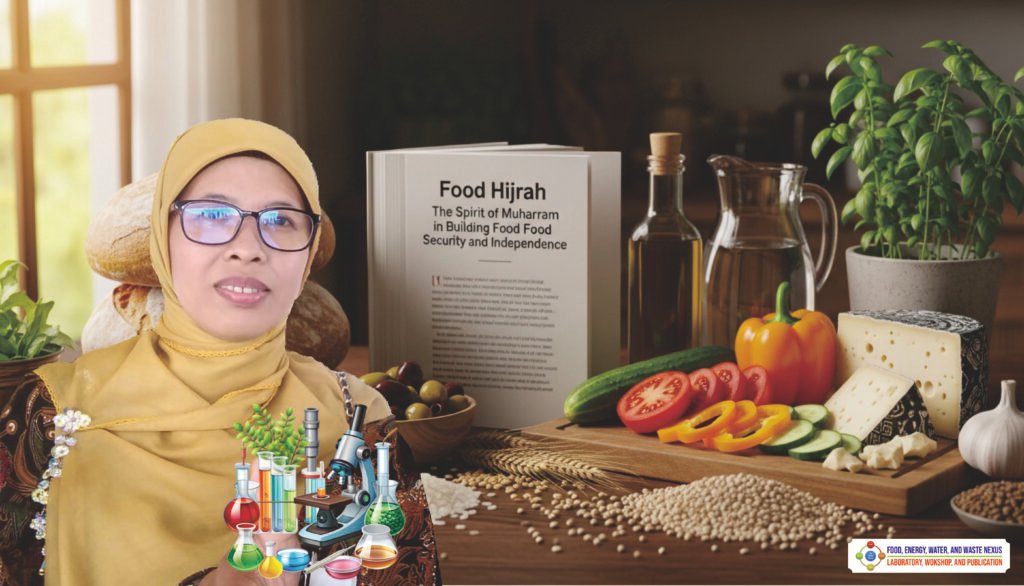
By: Kavadya Syska, S.P., M.Si. (Dosen Bidang Teknologi Pangan – Food Technologist, Universitas Nahdlatul Ulama Al Ghazali Cilacap / UNUGHA Cilacap)
Moving toward a strong, healthy, and sovereign food future is not merely an aspiration, but an urgent necessity for Indonesia. Food is the foundation of life, health, productivity, and civilizational sustainability. Without a resilient food system, a nation becomes vulnerable to economic crises, climate change, global supply chain disruptions, food scarcity, and unequal access to nutrition.
Muharram provides an important moment for reflection and renewal in the direction of national food development. The spirit of hijrah embedded in Muharram does not only refer to historical migration, but also to a paradigm shift toward a better life. In the context of food, hijrah can be understood as a movement of transformation from dependence toward independence, from unhealthy consumption toward nutritious dietary patterns, from wastefulness toward efficiency, and from a fragile food system toward a sustainable one.
Food hijrah is becoming increasingly important because today’s food challenges are no longer simple. Population growth, climate change, land degradation, agricultural land conversion, food loss, food waste, and dependence on certain imported food commodities show that the national food system must be strengthened comprehensively. Indonesia should not only increase production, but also improve processing technology, distribution, food safety, nutritional quality, shelf life, and the added value of local food products.
Within this framework, food technology plays a strategic role. Food technology does not only function to process raw materials into consumable products, but also serves as an important instrument to extend shelf life, maintain food safety, improve nutritional value, reduce postharvest losses, strengthen local food industries, and create product innovations that meet community needs. Thus, food hijrah is not only an agricultural agenda, but also a technological, economic, social, health, and civilizational agenda.
For Indonesia, the spirit of Muharram can serve as a moral foundation for reorganizing the national food system to become more just, independent, and sustainable. Food security should not only be understood as the availability of sufficient food, but must also include equitable access, safe quality, balanced nutrition, affordable prices, and the sustainability of natural resources. This is the true meaning of food hijrah: building a food system that does not merely satisfy hunger, but also nourishes, empowers, and brings public benefit.
Food Downstreaming in Indonesia
Food downstreaming in Indonesia plays a strategic role in driving the transformation of the national food system toward greater independence, competitiveness, and sustainability. Food downstreaming is not merely about processing agricultural products into finished goods. It includes strengthening the entire food value chain, from production, postharvest handling, processing, packaging, storage, and distribution to marketing. In this context, Indonesia must move from being a producer of raw commodities toward becoming a creator of high-value food products.
One of the main priorities of food downstreaming is strengthening local commodity-based food industries. Indonesia has vast food resources, including rice, maize, cassava, sago, coconut, coconut sugar, bananas, tubers, spices, legumes, marine products, and various local foods from different regions. However, many of these commodities are still sold in raw or semi-processed forms, so their economic added value remains suboptimal. Through food technology, local commodities can be transformed into products that are more stable, practical, nutritious, safe, and marketable.
The development of postharvest technology is also an important part of food downstreaming. Postharvest losses remain a major problem in the food system, especially in horticultural products, grains, plantation crops, and fisheries. Drying, cooling, controlled storage, active packaging, vacuum packaging, fermentation, pasteurization, sterilization, freezing, and minimal processing technologies can extend shelf life and reduce food losses. Therefore, food downstreaming not only increases economic value, but also strengthens national food availability.
In addition, strengthening food research and innovation is a key foundation for building food independence. Universities, polytechnics, entrepreneurship-based Islamic boarding schools, research institutions, and food industries must be encouraged to become centers for creating food technologies that are relevant to community needs. Innovations such as functional foods, halal foods, emergency foods, fortified foods, low-sugar foods, plant-based protein foods, gluten-free local foods, and environmentally friendly packaging need to be developed seriously so that Indonesia does not only become a consumer of global food trends, but also a producer of food innovation.
Food downstreaming must also reach the grassroots level through the empowerment of micro, small, and medium enterprises, cooperatives, Islamic boarding schools, and food-based villages. Many local food actors have great potential, but still face limitations in technology, quality standards, market access, packaging design, halal certification, distribution permits, and production management. Therefore, food downstreaming must be supported through technological assistance, business incubation, food safety training, financing access, and integration with digital markets.
With this approach, food downstreaming becomes not only an industrial strategy, but also a social strategy for creating economic equity. Farmers, fishers, livestock producers, MSME actors, rural women, and young generations can be involved as key actors in the national food ecosystem. Food hijrah must ensure that added value is not only enjoyed by large industries, but also flows to local communities as a new source of welfare.
Technological Challenges and Strategies for Food Independence
Building food security and food independence is not a simple task. One of the main challenges is the low adoption of food technology among communities and MSMEs. Many local food products have great potential, but have not yet been processed according to adequate quality, safety, and packaging standards. As a result, these products struggle to compete in modern markets, have short shelf lives, and are vulnerable to quality deterioration.
The next challenge is the gap between research and industrial implementation. Many food research outputs from universities and research institutions have not been fully applied in society or industry. This is caused by limited downstreaming of research results, weak collaboration between academics and business actors, and an underdeveloped food technology commercialization ecosystem. In fact, food research should become a source of real solutions to improve the safety, quality, efficiency, and competitiveness of the national food system.
Food safety is also a critical challenge. Food products that do not meet safety standards can endanger public health and reduce consumer trust. Therefore, education on sanitation, hygiene, Hazard Analysis and Critical Control Point, Good Manufacturing Practices, halal certification, nutrition labeling, and quality control must be expanded, especially for small and medium food industries. In the spirit of Muharram, maintaining food safety can be understood as part of a moral responsibility to protect the health of the community and the nation.
Changes in consumption patterns also require attention. The increasing consumption of ultra-processed foods, foods high in sugar, salt, and fat, and the low consumption of nutritious local foods can affect long-term public health. Therefore, food hijrah also means consumption hijrah: moving toward healthier, balanced, diverse, halal, safe, and locally based dietary patterns.
Food independence strategies must be carried out in an integrated manner. First, local food production and diversification must be strengthened so that Indonesia does not depend too heavily on imported commodities. Second, postharvest and processing technologies must be improved to reduce food losses and increase added value. Third, local food industries based on MSMEs and villages must be strengthened. Fourth, applied food research and innovation must be promoted. Fifth, literacy on healthy, halal, safe, and sustainable food must be expanded. Sixth, efficient food distribution and logistics systems must be developed so that food can be accessed equitably by all communities.
In this context, digital technology can also play a major role. Digitalization of food supply chains, product traceability systems, online marketing, food quality sensors, artificial intelligence for demand prediction, and food education platforms can strengthen the efficiency and transparency of the food system. Future food independence will not only be determined by land and production capacity, but also by the nation’s ability to master technology, data, innovation, and distribution networks.
The Spirit of Muharram in Building a Food Civilization
Muharram teaches that great change must begin with value-based awareness. In food development, this awareness means viewing food not merely as an economic commodity, but also as a trust of life. Food is connected to basic human rights, family health, the dignity of farmers, environmental sustainability, and the future of the nation’s generations.
The spirit of hijrah encourages society to leave behind old unproductive patterns in the food system. Food waste must be replaced by a culture of respecting food. Dependence on imported food must be reduced through the strengthening of local food. Unhealthy consumption must be redirected toward nutritious consumption. Production practices that damage the environment must be transformed into sustainable food systems. Technology that only pursues profit must be redirected toward public benefit.
A strong food civilization is one that is able to provide food that is sufficient, safe, halal, nutritious, diverse, affordable, and sustainable. This civilization is not built by the government alone, but also by farmers, fishers, MSME actors, academics, industries, Islamic boarding schools, families, and young generations. All parties have a role in creating a better food system.
Islamic boarding schools and Islamic educational institutions hold a strategic position in the food hijrah movement. Beyond serving as centers of moral and spiritual education, Islamic boarding schools can become centers for local food development, integrated agriculture, halal food processing, student entrepreneurship, and healthy consumption education. With their large number and wide distribution across regions, Islamic boarding schools can become models of community-based food independence.
Universities and research institutions must also take a greater role. Food technology education should not stop at laboratory theory, but must be connected to community needs. Students, lecturers, and researchers need to be encouraged to produce food innovations that are applicable, affordable, easy to implement, and directly beneficial to society. Research on drying, fermentation, packaging, fortification, functional foods, food safety, and food waste processing must be directed toward solving the nation’s real problems.
Thus, food hijrah is not merely a symbolic movement during Muharram, but a long-term transformation agenda. It connects spiritual values with technology, economic independence with social justice, and food innovation with environmental sustainability.
Conclusion
Food Hijrah: The Spirit of Muharram in Building Food Security and Food Independence emphasizes that food development is not only a matter of production, but also a structural transformation that simultaneously touches technological, economic, social, health, cultural, and spiritual dimensions. The spirit of Muharram provides a moral foundation that change toward a better food system must begin with awareness, be strengthened by knowledge, be realized through technology, and be directed toward the welfare of society.
For Indonesia, food hijrah is highly important amid the challenges of climate change, import dependence, postharvest losses, unequal access to food, low nutrition literacy, and weak downstreaming of local food products. Food downstreaming strategies play a central role in creating national food independence by focusing on strengthening local food industries, developing postharvest technologies, improving food quality and safety, advancing research-based innovation, empowering MSMEs, and strengthening food villages and productive Islamic boarding schools.
Without a comprehensive strategy oriented toward social justice, food development risks benefiting only certain groups while leaving vulnerable communities behind. Therefore, Indonesia needs to build food policies that are inclusive, long-term oriented, technology-based, and supportive of local independence. Food hijrah must become a collective movement to ensure that Indonesian food is not only sufficient in quantity, but also safe, halal, nutritious, competitive, and sustainable. By integrating the spirit of Muharram, food technology innovation, and commitment to national sovereignty, Indonesia has a great opportunity to build a food civilization that is independent, healthy, just, and beneficial for future generations.
